Your pool is losing water. You have topped it off three times this week, and the autofill never seems to shut off. So you start searching, and within about five minutes you have four phone numbers and four very different opinions about what is wrong.
Now you have a second problem. Which one of these people is telling you the truth?
That question matters more than most pool owners think. The first diagnosis drives everything that follows. Get it right, and you might replace a single fitting. Get it wrong, and you could pay to jackhammer a deck that never needed touching.
Below are twelve questions that separate a real leak specialist from someone hunting for a repair job. Plus the Arizona licensing rules that almost nobody bothers to explain.
What a Pool Leak Detection Company Actually Does in Arizona
A pool leak detection company finds where water is escaping your pool system. That sounds simple, but the work is diagnostic rather than mechanical. The technician collects clues, tests each suspect area, and rules things out until one answer is left.
This matters because pool leaks are not one problem. A leaking skimmer throat behaves nothing like a cracked return line. A failed light niche conduit looks nothing like a bad pump seal. Each one needs a different fix and a very different bill.
So the goal of the visit is not repair. The goal is an accurate answer to one question: where is the water going? Everything else waits until that is clear.
Arizona ROC Licensing: The First Thing to Verify
Every article on this topic tells you to “check licensing.” Almost none tell you what to actually check. So here is what an Arizona pool leak detection company should be able to hand you before the truck pulls up.
Which ROC License Classifications Cover Arizona Pool Work
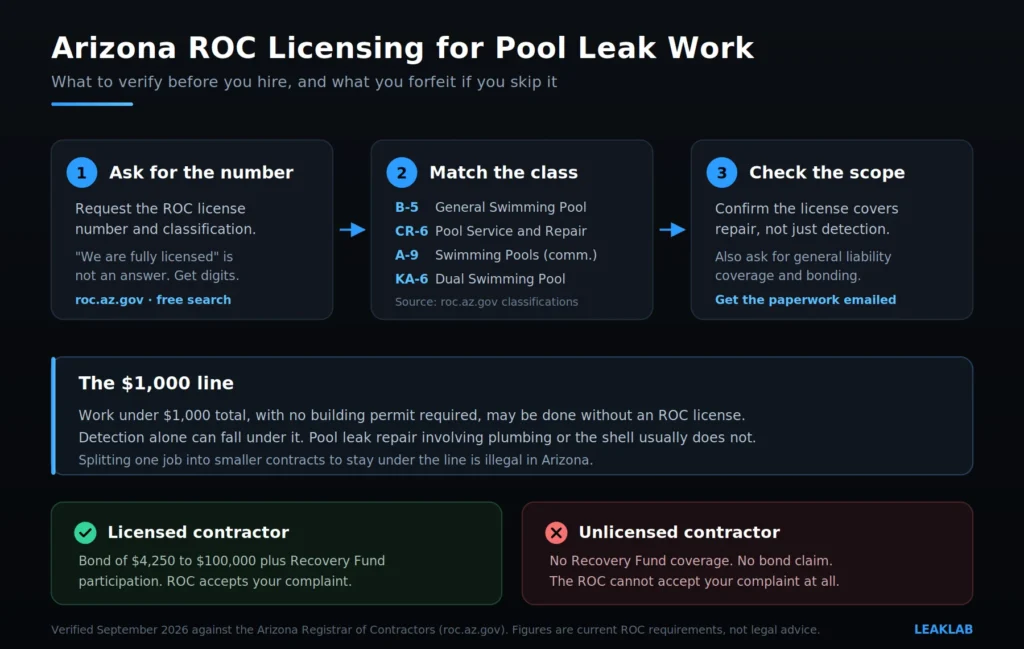
The Arizona Registrar of Contractors issues specific classifications. Pool work has its own. Four show up on the ROC license classifications list:
- B-5, General Swimming Pool Contractor (residential)
- CR-6, Swimming Pool Service and Repair (specialty dual license)
- A-9, Swimming Pools (commercial)
- KA-6, Dual Swimming Pool
Ask which classification the company holds. Then verify the license number yourself at roc.az.gov. The search is free and takes about thirty seconds.
The $1,000 Handyman Exemption Most Arizona Pool Owners Miss
Arizona lets someone perform contracting work without an ROC license in one narrow case. The total cost of labor and materials must come in under $1,000, and the job must not require a local building permit. That is the entire exemption.
A few details make it tighter than it sounds. The $1,000 ceiling covers everything, including materials and tax. Breaking a larger job into several smaller contracts to stay under the line is illegal. If the work needs a permit, you need a licensed contractor no matter what it costs. Plus, an unlicensed handyman has to state “not a licensed contractor” in every ad and contract.
Now apply that to your pool. Detection alone often lands under $1,000. The repair usually does not, especially once underground plumbing or the shell is involved. That gap is exactly where Arizona homeowners get burned.
The Recovery Fund Only Protects You If the Contractor Is Licensed
Arizona requires licensed residential contractors to carry financial protection for their customers, and swimming pool work is named specifically. To hold a license, a residential contractor posts a cash deposit or surety bond between $4,250 and $100,000. On top of that, they either pay into the Residential Contractors’ Recovery Fund or post a second $200,000 bond. Most choose the Fund.
Here is the catch. The Fund covers you only if the contractor was licensed. Unlicensed work is not covered at all, and the ROC cannot even accept your complaint. A two-year deadline also applies, and you must claim against the contractor’s bond first.
In short, hiring unlicensed does not just risk a bad repair. It removes every safety net the state built for you.
Questions 1 to 4: Licensing, Insurance, and Accountability
Start here, because these four decide whether you have any recourse later. A solid pool leak detection company answers all four without a pause or a change of subject.
1. What Is Your Arizona ROC License Number and Classification?
You want a number, not a promise. “We are fully licensed” is not an answer. Write the number down and check it yourself before anyone starts work.
2. Are You Bonded and Insured for Damage to My Deck and Plumbing?
Leak detection involves pressure testing lines and sometimes opening up access points. Things occasionally go wrong. Ask for general liability coverage and bonding, then ask them to email you the paperwork.
3. Do You Repair What You Find, or Hand Me Off to Someone Else?
Both models can work. But you deserve to know which one you are buying before the technician arrives. Otherwise you end the visit with an answer and no way to use it.
4. Who Is Actually Coming to My House?
Some companies dispatch subcontractors they have never trained. Ask whether the person arriving is an employee. Ask how long they have done leak work, and whether they handle pools, spas, and water features. Experience with your specific pool type matters too, since concrete, fiberglass, and vinyl all fail differently.
Questions 5 to 8: Detection Methods and Equipment
Gear questions tell you a lot, but not in the way most people expect. The best pool leak detection company is rarely the one with the longest gear list. It is the one that can explain why a given test fits your symptoms.
5. How Will You Find My Leak, and Why That Method?
Listen for a process, not a product pitch. Good answers mention dye testing around cracks and fittings. They also cover pressure testing on plumbing lines, acoustic listening for buried pipes, and sonar leak detection for harder finds.
6. Will You Test the Pool Both Running and Shut Off?
This one quietly tells you a lot. Water loss that only happens while the pump runs points toward pressure-side plumbing. Loss that continues when everything is off points somewhere else entirely. A technician who skips this step is guessing.
7. Can You Locate the Leak Without Digging Up My Yard?
Good methods find a leak before anyone picks up a shovel. Ask whether leaks can be detected without digging on your property. Digging is sometimes needed. Even so, it should never be the first move.
8. How Long Will the Inspection Take, and Do I Need to Be Home?
Most inspections run a few hours rather than a few minutes. Knowing how long pool leak detection takes helps you plan the day. It also flags anyone who promises a five-minute answer.
Questions 9 to 12: Price, Guarantees, and Written Proof
Money questions come last on purpose. Once you understand licensing and method, price finally means something. A straight-talking pool leak detection company will give you clear numbers, not a range so wide it says nothing.
9. What Does Your Price Include, and What Triggers an Extra Charge?
Ask what the base fee covers and what adds cost. Multiple suspected leaks, underground plumbing, and spa or water feature testing often sit outside a basic inspection.
10. What Happens If You Cannot Find the Leak?
Honest techs admit that some leaks hide well. Ask what they do next and whether you still pay. Some companies offer a no-find, no-pay policy, and it is worth asking about.
11. Do You Guarantee the Find, and for How Long?
Several Arizona companies advertise a thirty-day guarantee. Ask what the guarantee actually covers, because “we guarantee our work” and “we will return free if the leak continues” are very different promises.
12. Will I Get a Written Report With Photos?
Ask for it in writing. You want the leak location marked, photographs of what was found, and a plain note on the repair needed. Without that, comparing repair bids later gets very hard.
Detection Only or Detection and Repair: Which Do You Need?
This choice trips up more Arizona pool owners than any other. There is a real argument on both sides. The right pool leak detection company for you depends on which risk bothers you more.
A detection-only specialist has no financial stake in the repair, so the answer carries less built-in bias. The tradeoff is the handoff. You get an answer, then you go find someone to act on it, and nobody owns the end result.
A company that does both keeps one team accountable from diagnosis through pool leak repair. The work moves faster and the calls get simpler. Even so, the same business benefits from the repair it recommends. That is not always a problem. Still, the answer should be clear to you before you approve anything.
Either way, the test is the same. Can they show you where the leak is and how they confirmed it?
What Pool Leak Detection Costs in Arizona
At LeakLab, pool leak detection runs $450 to $900. Any pool leak detection company advertising a far lower starting price deserves a follow-up question about what that fee actually covers.
Three things decide where a job lands in that range. Pool size comes first, because a larger pool means more surface, more fittings, and more area to test. Next is how much plumbing is involved, since every suction line, return line, and buried run adds testing time. Last is whether other bodies of water connect to the pool. A spa, a water feature, or a shared equipment pad each needs testing in its own right.
Be careful at both ends. A very cheap inspection can turn into a sales call for repairs you do not need. Meanwhile, a pricey one proves nothing by itself. Weighing the spend? It helps to think through whether pool leak detection is worth it in Arizona before you book. Also check whether homeowners insurance covers pool leak detection in Arizona, because some policies help with access costs.
Service Areas and Travel Fees Across Arizona
Most search results for pool leak help cover one metro area. That is fine in Chandler. It becomes a real issue in Prescott, Payson, Show Low, Sierra Vista, or Lake Havasu. Out there, a Valley-based pool leak detection company may quietly decline the job or add travel to the bill.
So ask two plain questions before booking. Do you service my city? And does my location change the price?
Arizona also spans several climates. That changes what fails. Valley pools deal with extreme heat, hard water scale, and caliche soil. Pools at elevation face freeze and thaw cycles that stress tile lines, plumbing, and equipment in ways Valley pools never see. A company that works statewide should be able to talk about your region by name. You can see how we approach leak detection in Arizona across different parts of the state.
Red Flags When Hiring a Pool Leak Detection Company
A few warning signs show up again and again. None of them prove bad intent alone. Together, though, they should slow you down before you hand over a deposit. Any pool leak detection company doing these things is worth a second opinion.
- A firm diagnosis over the phone. Nobody can identify your leak without testing your pool.
- Digging recommended before locating. Excavation follows a finding. It should not replace one.
- No ROC number on the estimate or invoice. This is the fastest disqualifier on the list.
- Pressure to decide today. Real urgency gets explained. Fake urgency just gets repeated.
- A replaster pitched before a leak is confirmed. Resurfacing is a big job and sometimes the right call. Even so, it should never be the first one.
- Vague findings. If they cannot explain what failed and how they confirmed it, you cannot judge the repair.
Rule Out Evaporation Before You Call Anyone
One last step can save you the service fee. Before you hire a pool leak detection company, make sure the water loss is really a leak.
Arizona summers pull off a surprising amount of water. Wind, low humidity, heat, splash-out, and an uncovered surface all add up fast. A bucket test takes a day and costs you nothing. Our guide on telling a pool leak or just evaporation walks through it step by step.
If the bucket test says leak, you are no longer guessing. Better still, you go into the call with real facts.
Frequently Asked Questions About Hiring a Pool Leak Detection Company
A handful of questions come up on nearly every call, so a good pool leak detection company should answer each one plainly.
How much does pool leak detection cost in Arizona?
At LeakLab, pool leak detection runs $450 to $900. Three things decide where a job lands in that range: the size of the pool, how much plumbing needs testing, and whether other bodies of water such as a spa connect to the system. Ask any company for a written scope so you know what the base fee covers and what counts as an extra.
What is the best equipment for detecting swimming pool leaks?
There is no single best tool. Pressure testing checks whether plumbing lines hold. Acoustic listening equipment picks up water escaping underground. Dye testing confirms movement at cracks and fittings, and sonar helps pinpoint difficult finds. Still, choosing the right test for your symptoms matters far more than owning every device.
Are pool leak detection companies worth it?
Usually, yes. The costly mistake is rarely the inspection fee. It is paying to replace plumbing, equipment, or a pool surface that was never the problem. A correct answer often costs less than one repair you did not need.
How do I check if a pool leak detection company is licensed in Arizona?
Ask for the ROC license number and classification. Then search it free at roc.az.gov. For pool work, look for B-5, CR-6, A-9, or KA-6. Remember that the Residential Contractors’ Recovery Fund does not cover unlicensed work. So checking the number protects your ability to recover money later.
What is the easiest way to find a leak in my pool?
Start with a bucket test to separate a real leak from evaporation. After that, check the equipment pad for wet spots. Then watch whether the water loss changes when the pump runs. Our guide on pool leak detection services explains what happens once professional testing begins.
Hiring a Pool Leak Detection Company You Can Actually Verify
A leaking pool is stressful enough without wondering whether you are being told the truth. The right pool leak detection company does not ask you to take its word for anything. It gives you a license number you can look up, a method it can explain, and a written finding you can hand to anyone.
At LeakLab, leak detection is the only thing we do. Brandon has spent more than thirteen years finding leaks in pools, spas, fountains, and water features across Arizona. For us, the work is diagnostic long before it is ever mechanical. You can read more about our team or get in touch when you want a real answer.
Ask the twelve questions above. Whoever you hire should welcome every one of them.