Pool leak detection in Mesa, AZ typically takes 2–6 hours for a standard inspection, though complex cases involving underground plumbing can extend to a full day. Here’s everything you need to know — from what causes leaks to why a wet spot near your equipment pad is a red flag you shouldn’t ignore.
In this guide
- Quick answer: how long does detection take?
- What is a wet spot near pool equipment — and why it matters in Mesa
- How pool leak detection works, step by step
- Factors that affect detection time
- Detection methods explained
- How long do pool leak repairs take?
- Prevention tips for Arizona pools
- FAQ
Quick answer: how long does pool leak detection take?
Pool leak detection takes 2 to 6 hours on average. A simple leak in a skimmer, fitting, or light fixture can be confirmed in 1–2 hours using dye or pressure testing. Leaks in underground plumbing or the pool shell may require 4–8 hours of systematic testing. Unusually complex pools with spas, water features, or in-floor cleaning systems can take a full day. In Mesa, AZ’s intense heat, early detection is especially critical — evaporation can mask a slow leak, causing homeowners to lose thousands of gallons before acting.
| Leak type | Typical detection time | Common Mesa scenario |
|---|---|---|
| Skimmer or fitting leak | 1–2 hours | Fittings loosened by ground shift in clay-heavy East Mesa soil |
| Pool light or return jet | 1–3 hours | UV degradation on niche gaskets from AZ sun exposure |
| Shell crack (plaster/gunite) | 2–5 hours | Thermal expansion cracks from extreme summer heat cycles |
| Underground plumbing | 4–8+ hours | Caliche soil shifting causing pipe joint failures |
| Multiple leak sources | Full day | Pools with spa, waterfalls, and in-floor cleaning systems |
What is a wet spot near pool equipment?
A wet spot near pool equipment is a damp, saturated, or muddy area of soil or deck close to your pump, filter, heater, or plumbing manifold. In the context of pool leak detection, it is one of the most reliable visual indicators that water is escaping your pool’s pressurized plumbing system — either through a cracked pipe, a failed union fitting, a leaking valve, or a degraded seal at the equipment pad. If you notice persistent moisture near your equipment in Mesa’s desert climate, professional leak detection on pools should be scheduled promptly.
In Mesa, Arizona, wet spots near equipment are taken especially seriously because the desert climate means your yard should almost never be wet. If you see dampness, soggy ground, or unexpected grass growth near your pool equipment pad when it hasn’t rained, something is wrong.
Leak detection on pools — LeakLab AZ
Serving Mesa, Gilbert, Chandler, Tempe, and the greater East Valley with same- and next-day inspections.
Why wet spots near equipment are a red flag in Arizona
Arizona’s arid climate creates a stark contrast: dry, cracked soil everywhere except right next to your equipment. That’s precisely what makes wet spots so diagnostic here. Even a slow drip of a gallon per hour will create visible saturation within 24–48 hours in desert soil that holds virtually zero moisture naturally.
Mesa’s specific geology adds another layer of concern. Caliche — the calcium carbonate hardpan common throughout the East Valley — can cause pipes to shift and crack as soil expands and contracts with temperature and moisture changes. This means underground leaks around the equipment pad are more common here than in many other states.
Common causes of a wet spot near pool equipment in Mesa, AZ
- Failed union fittings — The threaded plastic unions connecting pipes to your pump and filter are common failure points. Heat cycles from Mesa’s 110°F+ summers cause them to expand and contract, eventually cracking or loosening the O-ring seal.
- Cracked PVC supply or return lines — Underground pipes running from the equipment pad back to the pool can crack due to soil movement, caliche shifting, or UV and thermal fatigue on any exposed sections.
- Leaking pressure-side return lines — The pressurized line leaving your pump carries water at higher force; even small cracks release significant water volume underground, eventually saturating the soil above.
- Loose or corroded backwash valve — Sand filter backwash valves can develop slow drips that pool in the gravel or soil beneath the equipment pad.
- Heater heat exchanger leak — Gas pool heaters have internal copper or cupronickel heat exchangers that corrode, especially when pool chemistry runs acidic — common when Mesa’s hard fill water throws pH balance off.
- Air relief valve dripping — The small bleeder valve on top of cartridge or DE filters is often overlooked but can drip continuously, creating a persistent wet patch.
Mesa homeowner tip: Check your water meter before calling a tech. Turn off everything in your house, note the meter reading, and check again in exactly 1 hour without using any water. If the meter moved, you have a leak somewhere — and if your pool is the suspect, a wet equipment area makes it very likely the culprit is there.
How pool leak detection works, step by step
A professional leak detection on pools doesn’t just poke around randomly. The process is systematic, moving from general to specific so technicians can isolate the leak source efficiently.
- Initial visual inspection — The tech walks the entire pool perimeter looking for cracks in plaster or tile grout, signs of settling or sunken decking, staining around lights or returns, and obvious wet patches near equipment.
- Equipment pad assessment — All valves, unions, fittings, the pump lid O-ring, filter tank seals, heater connections, and automation manifolds are inspected under pump pressure for active drips or seeps.
- Bucket test (or meter reading) — Confirms that water loss exceeds normal evaporation. Mesa’s summer evaporation rate can reach ½ to 1 inch per week, so this step prevents chasing a phantom leak.
- Pressure testing of plumbing lines — Each line (skimmer, main drain, returns, spa, cleaner) is isolated, capped, and pressurized with air or water. If the pressure drops on a specific line, the leak is in that section.
- Dye testing — With the pump off and water still, a non-staining dye is slowly released near suspected areas (cracks, lights, fittings, steps). If a leak is present, the dye streams toward and into the opening.
- Hydrophone / sonar listening — For underground leaks, specialized electronic listening devices detect the ultrasonic sound of pressurized water escaping a pipe, allowing the tech to trace the leak path above ground without excavating.
- Thermal imaging (if available) — For heated pools and spas, thermal cameras detect temperature anomalies in the deck or soil that reveal where warm water is escaping underground.
Factors that affect detection time in Mesa, AZ
Pool size and complexity
A basic 15×30 rectangular pool with a single pump has far fewer potential leak points than a freeform pool with an attached spa, beach entry, waterfall feature, in-floor cleaning system, and swim-up bar. Each added feature introduces more plumbing lines, fittings, and structural seams — all of which require systematic testing.
Location of the suspected leak
Leaks above grade at the equipment pad are usually found quickly. Leaks in underground plumbing running beneath the pool deck or patio take longer because the tech must pressure-test multiple lines sequentially to isolate which one is compromised, then use acoustic equipment to find the specific underground location.
Severity and clarity of signs
A visible crack in the plaster that dye confirms immediately takes minutes to diagnose. A slow seep losing a quarter inch of water per week with no obvious signs is far more elusive and requires methodical elimination testing.
Mesa’s evaporation rate
Arizona pools lose significant water to evaporation — especially from May through September when temperatures exceed 105°F and relative humidity is below 15%. This makes it essential to confirm actual leakage (beyond evaporation) before starting the diagnostic process, which adds time but prevents wasted testing.
Age and condition of the pool
Older Mesa pools — particularly those built in the 1980s and 1990s during the Valley’s rapid residential expansion — often have original plaster, galvanized fittings, and older PVC more prone to multiple simultaneous failures. Finding all active leaks in an aging pool takes longer than diagnosing a new build with a fresh shell.
Detection methods explained
The bucket test
Fill a 5-gallon bucket with pool water and set it on a step so it’s half submerged. Mark the water level inside and outside the bucket. Wait 24 hours (without running the pool). If the pool water level has dropped more than the bucket’s, the difference indicates a leak. This is a homeowner screening tool — it confirms a leak exists but does not locate it.
Dye testing
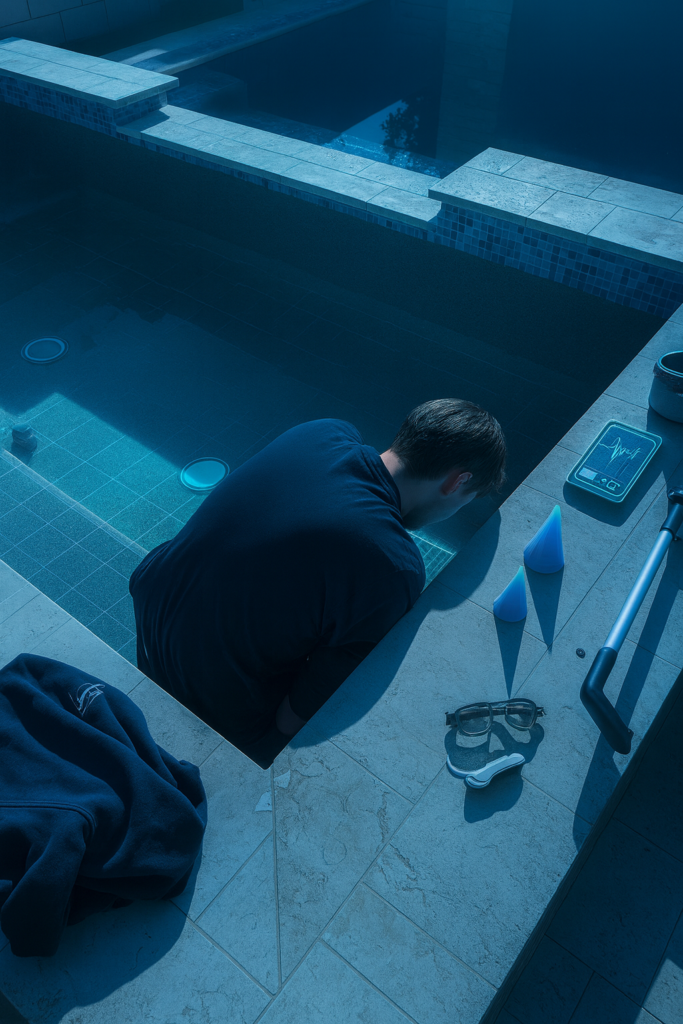
A technician uses a syringe to release a small stream of non-staining dye near suspected leak points with the pump off and water calm. Any crack, gap, or compromised fitting draws the dye toward and into the opening. Dye testing is highly effective for skimmers, light niches, main drains, and shell cracks. For deep floor cracks or main drains, a technician may use scuba gear to get close enough for accurate results.
Pressure testing
Each plumbing line is isolated at the equipment pad using caps and plugs, then pressurized with air or water to a known PSI. A properly sealed pipe holds pressure indefinitely. A drop in pressure — measured via gauge — confirms a leak in that specific line. Pressure testing must always be performed by a licensed professional, as over-pressurizing lines can cause blowouts and additional damage.
Hydrophone and sonar testing
When a pressurized underground pipe has a crack or joint failure, water escaping through the breach creates a distinct ultrasonic frequency. Electronic hydrophones detect and amplify this sound through the ground surface, allowing technicians to trace the leak’s location by walking the deck and listening for signal peaks — no excavation required until the precise spot is confirmed. This technology dramatically reduces the time needed to locate underground pipe leaks in large Mesa-area properties.
Thermal imaging
Infrared cameras detect temperature differences in surfaces. When a heated pool or spa leaks water into surrounding soil, the warm water creates a thermal anomaly visible to the camera. This is particularly useful for slab-deck pools and patio areas where acoustic testing is limited by the hard surface above the pipes.
How long do pool leak repairs take after detection?
Pool leak repair time ranges from 1 hour to several days depending on the source. Equipment pad repairs (fittings, unions, O-rings, valves) are typically completed same-day in 1–3 hours. Shell crack repairs require surface prep, epoxy or hydraulic cement application, and 24–72 hours of cure time. Underground pipe repairs require locating, excavating, patching or replacing the pipe section, and backfilling — typically 1–2 days. For a full overview of repair timelines and costs, see our guide to pool leak repair in Mesa, Arizona.
Pool Leak Repair in Mesa, Arizona — LeakLab AZ
Everything you need to know about repair timelines, costs, and what to expect after your leak is located.
| Repair type | Repair time | Pool downtime |
|---|---|---|
| Union fitting / O-ring replacement | 1–2 hours | Same day |
| Valve or backwash seal | 1–3 hours | Same day |
| Pool light niche / gasket | 2–4 hours | Same day – 1 day |
| Skimmer crack or throat repair | 2–4 hours + cure | 24–48 hours |
| Plaster / gunite shell crack | Half day + cure | 24–72 hours |
| Underground pipe (access + repair) | 1–2 days | 1–3 days |
| Full replaster (extensive shell damage) | 3–5 days | 7–14 days (cure + fill) |
Pool leak prevention tips for Mesa, AZ homeowners
Maintain balanced water chemistry
Mesa’s fill water is notoriously hard — high in calcium and carbonates. When combined with high heat and evaporation concentrating minerals, pool water can swing toward scale-forming alkalinity or, if over-treated, toward corrosive low-pH. Corrosive water dissolves plaster surfaces, corrodes metal fittings, and degrades heater heat exchangers. Test your water weekly during summer and monthly in winter, and keep pH between 7.4 and 7.6.
Inspect equipment pad fittings annually
Every spring before monsoon season and heavy use, have a technician inspect all union fittings, valve seals, pump lid O-rings, and plumbing connections at your equipment pad. O-rings that are cracked or flat from UV and heat exposure should be replaced proactively — they cost a few dollars; the water bill from ignoring them does not.
Check sealant around coping and tile line
The bead of sealant between your pool’s bond beam and coping stones is the first line of defense against water infiltrating behind your shell. In Arizona’s thermal environment — cold nights, extreme daytime heat — this sealant cracks and pulls away faster than in moderate climates. Inspect it annually and re-caulk any gaps before they become pathways for water migration.
Act fast on small issues
A dripping valve, a hairline crack in a step, a loose fitting at the equipment pad — each is a $50–$200 repair today and a potential $2,000–$10,000 repair if ignored for a season. Mesa’s soil instability means small leaks don’t stay small; water escaping underground erodes soil, undermines decking, and destabilizes pool shells. If you spot any of these warning signs, get professional leak detection on pools scheduled before the problem compounds.
Frequently asked questions
How much water does a pool lose to evaporation in Mesa, AZ?
In peak summer (June–August), Mesa pools can lose ½ to 1 inch of water per week to evaporation alone due to extreme heat and very low humidity. If your pool is losing more than 1 inch per week, especially if you notice a wet spot near your equipment pad, a leak is likely present alongside evaporation losses.
Can I do pool leak detection myself?
Homeowners can perform the bucket test to confirm a leak exists. Dye testing with a syringe kit from a pool supply store is also a DIY option for visible suspect areas like lights or skimmers. However, pressure testing of plumbing lines carries risk of pipe damage if done incorrectly and should only be performed by licensed professionals. Hydrophone and thermal imaging require specialized equipment not practical for homeowners to rent or operate.
What does a wet spot near pool equipment mean?
A wet spot near pool equipment — your pump, filter, heater, or plumbing manifold — means water is escaping the system at or underground near that location. In Mesa’s desert environment, where the soil is naturally bone-dry, any persistent moisture near equipment is a reliable indicator of an active plumbing or equipment seal leak. You should schedule professional leak detection on pools promptly.
How much does pool leak detection cost in Mesa, AZ?
Pool leak detection in the Mesa/East Valley area typically ranges from $150 to $450 for a standard inspection using dye and pressure testing. Inspections requiring hydrophone sonar work or thermal imaging for underground leaks may cost $300–$600+. Most reputable companies apply the detection fee toward any repair work booked through them.
Is pool leak detection covered by homeowners insurance?
Detection services are generally not covered by standard homeowners insurance, but repair costs for sudden, accidental leaks — like a burst underground pipe — may be covered under your dwelling or other structures coverage. Gradual leaks and maintenance-related failures are typically excluded. Review your specific policy and document all findings with photos and a written report from your leak detection company before filing any claim.
How do I know if my pool is leaking or just evaporating?
Perform a bucket test: mark the water level in a half-submerged bucket and in your pool simultaneously. After 24 hours, compare the two drops. If the pool dropped significantly more than the bucket, you have a leak beyond normal evaporation. A leak is also suggested if water loss increases when the pump is running (pressure-side leak), decreases when the pump is off, or if you spot wet soil near equipment or around the pool deck.
How long can I wait before getting a pool leak fixed?
You should not wait. Every day a pool leak goes unrepaired in Mesa costs you in three ways: higher water bills (the average leak loses 1,000–2,000 gallons per day), chemical costs (you’re constantly adding chemicals to refill water that drains away), and structural risk (water migrating through soil undermines pool shells, decks, and foundations). Same-week service is strongly recommended. Learn more about what happens next on our pool leak repair in Mesa, Arizona page.
Suspect a leak? LeakLab AZ serves Mesa, Gilbert, Chandler, Tempe, and the greater East Valley. Our technicians use pressure testing, dye testing, hydrophone sonar, and thermal imaging to find pool leaks fast — usually same or next day. Call or text us to book an inspection.