

Your floor is warm in one spot, the water bill jumped, and now you are reading your policy for the first time. Most homeowners arrive here in exactly that order.
Here is the short version. A standard Arizona policy pays for the damage the water did. It usually will not pay for the pipe that failed. And whether it pays at all comes down to a single distinction that almost nobody explains to you.
So let’s walk through it, because the choices you make in the first few days decide the outcome.
What Slab Leak Insurance Covers in a Standard Arizona Policy
Slab leak insurance on a standard HO-3 policy covers the damage, not the plumbing. That is the simplest way to hold it in your head.
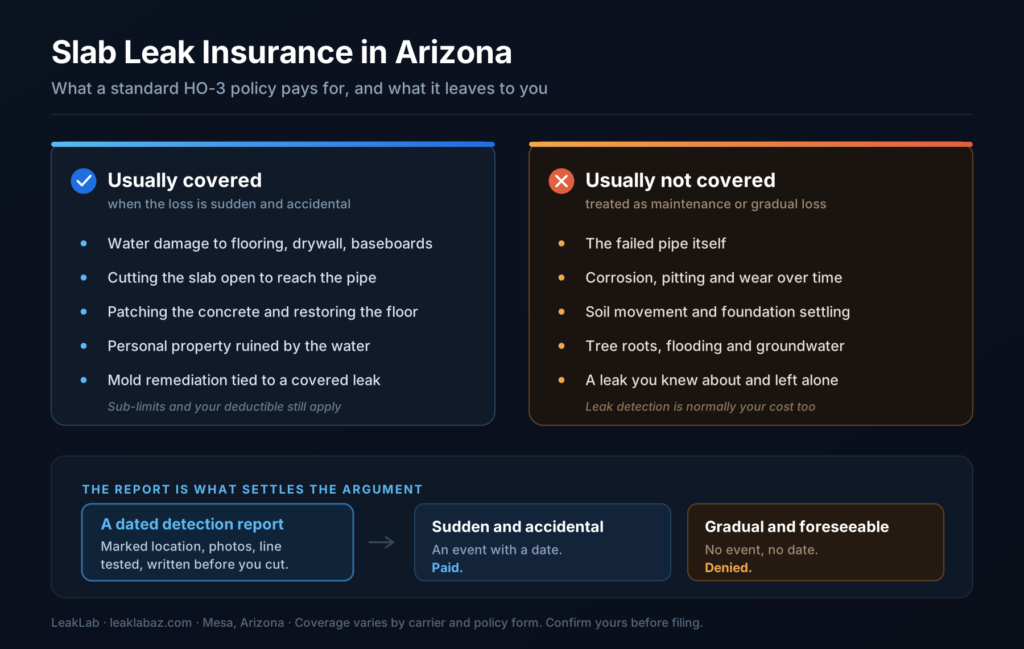
Most Arizona policies will pay for three things. First, the resulting water damage, meaning flooring, drywall, baseboards and anything structural the water ruined. Second, access costs, which is the labor to cut through the concrete to reach the pipe and then patch it back. Third, personal property, so furniture, rugs and electronics, up to your personal property limit.
Broader forms help here. An HO-3 or HO-5 policy treats water damage far more generously than a basic HO-1. If you have never checked which form you hold, now is a good moment.
One more thing to watch. Even a covered claim can run into a sub-limit, which is a cap your carrier places on a specific category such as foundation work. Coverage and payment are not the same thing.
What Slab Leak Insurance Will Not Pay For
The exclusions on slab leak insurance surprise people more than the coverage does, so read this part twice.
Your policy almost certainly will not pay to repair the failed pipe itself. Carriers treat plumbing as maintenance, which is your responsibility rather than theirs. That holds true even when they cheerfully pay to replace the floor above it.
Carriers exclude several causes outright. Gradual corrosion and wear are the big ones. They also exclude soil movement and foundation settling, along with tree roots, outside flooding and groundwater, construction defects, and any leak you knew about and left alone.
That last one deserves emphasis. If you noticed the signs in March and called in September, your carrier can treat the delay as negligence.
Sudden Versus Gradual: The One Distinction That Decides Your Claim
Nearly every slab leak insurance decision comes down to whether the loss was sudden and accidental or gradual and foreseeable. Everything else is detail.
What an adjuster counts as sudden
A pipe that bursts counts. So does a line a contractor drove a stake through, a water heater that ruptured, or damage somebody caused on purpose. The common thread is an event with a date.
Gradual is the opposite. A pinhole that wept for eight months has no event and no date, so the carrier files it under wear and tear and declines.
Why Arizona pipe failures often read as gradual
This is where Valley homeowners get squeezed. Our two most common failure modes both look like slow decay on paper.
Aggressive water chemistry pits copper from the inside over years. Pipe that crosses rebar or rests on rough concrete abrades a little more with every hot water draw. Neither one is dramatic, and an engineer sent by your carrier will describe both as deterioration.
But the pipe failing slowly and the water escaping suddenly are two different events. A pinhole that finally opens releases water on a date. Making that distinction visible is the whole game, and it is won with evidence rather than argument.
Why Arizona Homes Generate So Many Slab Leak Insurance Claims
Three local conditions stack up, and together they explain why slab leak insurance questions come up so often across Maricopa County.
Valley homes sit on slab on grade. There is no basement and no crawlspace, so the supply lines sit in or under the concrete your house rests on. Nothing is accessible, and nothing announces itself early.
Our water is hard, and hard water corrodes copper from the inside out. Meanwhile caliche and expansive soils shift with moisture and put steady stress on rigid pipe.
Then there is age. A large share of Valley homes now have plumbing at or past its service life, which is why the calls cluster in certain subdivisions and certain build years.
The Document That Decides a Slab Leak Insurance Claim
Here is the part the other articles skip. Evidence decides a slab leak insurance claim, and that evidence is a dated detection report, written before anyone opens the concrete.
An adjuster wants four things. They want to know where the leak is, what line it is on, when it was found, and what condition the surrounding plumbing is in. A report that answers all four, with photos and a marked location, settles the sudden versus gradual argument before it starts.
A verbal estimate does none of that. Neither does a floor that someone already opened in three places while guessing.
This is why we built LeakLab around locating first. We confirm the loss, isolate and pressure test each line separately, pinpoint the escape point acoustically through the slab, then verify before anyone cuts. Every slab leak detection in Arizona job ends with a marked spot on your floor and a written report the same day, backed for two years.
To be straight with you, your policy probably will not reimburse the detection itself. Most carriers treat it as a diagnostic cost. The report still pays for itself, because it is the document that turns a denied claim into a paid one.
The Order of Operations That Protects Your Slab Leak Insurance Claim
Sequence matters more than speed with slab leak insurance, and most people get the order wrong.
Start by shutting off the main if the loss is significant. Your policy requires you to limit the damage, and failing to do so is itself grounds for a reduced payout.
Next, photograph everything before you clean up. Wet flooring, stained drywall, damaged belongings, and the meter reading itself. Then get the leak located and documented in writing.
Call your carrier before repair work begins, not after. Ask two specific questions: whether your policy covers slab access and restoration, and how it treats sudden versus gradual water loss. Get the answers by email so you have them in writing.
Finally, keep every receipt and every message. Claims are won on paper.
When Filing a Slab Leak Insurance Claim Is Not Worth It
Sometimes the right move on slab leak insurance is to pay for the work yourself, and a good contractor will say so.
Compare the repair against your deductible first. If the job lands close to it, you are filing for very little. A single claim can raise your premium noticeably at renewal, and carriers look back five years or more when they decide whether to renew you at all.
That said, check your policy’s reporting requirements. Many policies require you to notify the carrier that damage occurred even when you do not intend to collect.
Frequently Asked Questions
How expensive is it to fix a slab leak?
It depends on depth, access, flooring type, and whether the fix is a spot repair or a reroute of the whole run. Restoration is often the larger half of the bill. Call us at (602) 622-8390 and we will give you a free estimate for your specific situation.
What is the most common damage to your home that insurance does not cover?
Gradual water damage, by a wide margin. Carriers exclude anything they can classify as long term seepage, corrosion or wear, which is exactly why the date on your documentation matters so much.
What happens if you have a water leak under your slab?
The water saturates the soil supporting your foundation. Over time that erodes the support, which leads to settling and cracking, and the moisture feeds mold inside wall assemblies. It does not stop on its own, and the repair gets larger every month.
What should I not say to my insurance company?
Avoid guessing about how long the leak has been running. If you say it has probably been going for a while, you have handed the carrier a gradual classification. Report what you observed and when, and let the detection report speak to the rest.
Does insurance pay for slab leak detection?
Usually not. Most policies treat detection as a diagnostic expense you cover yourself. If the leak is covered and detection required opening walls or flooring, restoration of those areas may be reimbursed.
Will my claim be denied if my house is older?
Not automatically, though age invites scrutiny. Carriers look harder at older plumbing, so documentation of when the leak was found carries more weight on an older home, not less.
Locate the Leak Before You File a Slab Leak Insurance Claim
A slab leak insurance claim goes far better when you open it with facts instead of guesses. So before you call your carrier, find out exactly what you are dealing with.
We locate the leak without digging, mark the spot on your floor, and hand you a written report the same day, backed by a two year guarantee.
Call LeakLab at (602) 622-8390 for a free estimate.