
- Pool Leak Detection Specialists
Pool Leak Detection Paradise Valley, AZ
LeakLab provides professional pool leak detection Paradise Valley homeowners can verify. Using advanced sonar, individual pressure testing on every plumbing line, and dye verification, we locate exactly where your pool is losing water without digging, draining, or guessing. Every inspection ends with a full written report you can hand to a contractor, an HOA board, or an insurer.
Why Paradise Valley Homeowners Choose LeakLab for Pool Leak Detection
Individual Line Pressure Testing
Most pool leak detection companies test the plumbing system as a whole. LeakLab tests every line independently: skimmer lines, return lines, main drain, spa circuits, in-floor cleaning system zones, negative-edge return lines, and water feature lines are each isolated and pressure-tested separately.
Sonar Leak Detection Up to 4 Feet Underground
LeakLab uses professional-grade sonar to detect pool leaks up to four feet below Paradise Valley’s decking, hardscape, and landscaping without breaking any surface. Underground plumbing failures that are completely invisible above ground are located accurately using sonar before any excavation is considered.
Angled Mirror Inspection
Paradise Valley pools with grottos, negative edges, and deep basin structures hide leaks in places standard inspection equipment cannot reach. LeakLab’s specialized angled mirrors allow structural inspection of surfaces that other pool leak detection companies miss entirely.
High-Powered Camera Inspection
When sonar and pressure testing confirm a subsurface pool leak, LeakLab can deploy inspection cameras to visually document cracked PVC lines inside plumbing systems. Camera evidence supports repair decisions, insurance claims, and property records on Paradise Valley estates.
Written Report at Every Inspection
Every LeakLab pool leak detection inspection in Paradise Valley ends with a full written report documenting all test results, confirmed leak locations, and repair recommendations. This documentation is suitable for HOA board review, estate records, and insurance purposes.
No Repair Without Confirmed Location
LeakLab never recommends a pool leak repair until the leak location is confirmed by at least two independent detection methods. This standard protects Paradise Valley homeowners from unnecessary demolition.
Our Process
How LeakLab Performs Pool Leak Detection in Paradise Valley
Every pool leak detection inspection in Paradise Valley follows the same six-step process. Every step is designed to narrow the source of water loss with data before any repair is recommended.
01. Water Loss Evaluation
We measure your pool’s actual water loss rate against Paradise Valley evaporation baselines, accounting for negative-edge splash, heated pool evaporation, and seasonal variables.
02. Structural Inspection
A comprehensive visual inspection of the pool shell, tile line, skimmers, returns, light niches, drains, bond beams, spillways, grotto surfaces, and all structural penetrations.
03. Individual Plumbing Line Pressure Testing
Every plumbing line in your Paradise Valley pool is isolated and pressure-tested independently.
04. Sonar and Electronic Detection
Professional sonar detects pool leaks up to four feet underground.
05. Dye Testing and Verification
Controlled dye testing visually confirms the exact pool leak location.
06. Written Report
A full written report documents every test result, confirmed leak location, and repair recommendation, delivered at the end of every pool leak detection inspection.
Why Paradise Valley Pools Are Harder to Diagnose
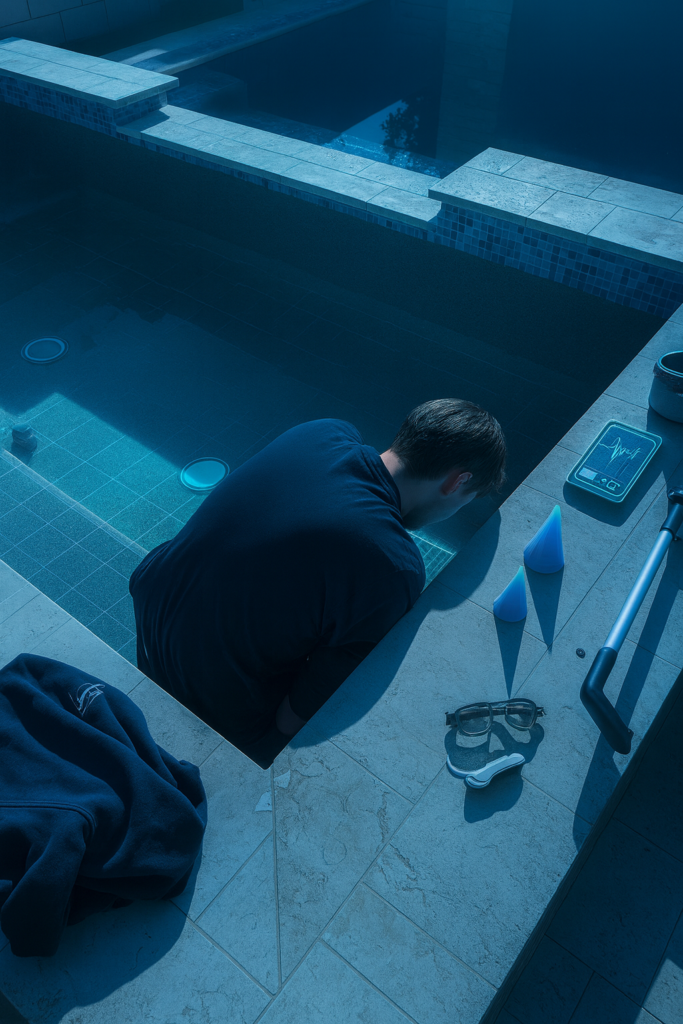
Paradise Valley backyards are not standard builds. Estate properties here routinely combine a main pool with a spa, a negative edge, a grotto or rock feature, an in-floor cleaning system, and one or more decorative fountains, all sharing an equipment pad and often running on separate circuits. Each of those systems is a separate potential source of water loss, and each needs to be isolated and tested on its own before anything can be ruled out.
The terrain adds to it. Properties on and around Camelback Mountain and Mummy Mountain sit on rocky, uneven grade, which means longer plumbing runs, more elevation change between pool and equipment, and buried lines that are harder to reach and more expensive to open up. Getting the diagnosis right the first time matters more here than almost anywhere in the Valley, because the cost of an exploratory dig on hardscape, mature landscaping, or a travertine deck is not trivial.
LeakLab serves properties throughout Paradise Valley, including Camelback Mountain, Mummy Mountain, Clearwater Hills, Cheney Estates, Casa Blanca, and Tatum Canyon.
What Does Pool Leak Detection Cost in Paradise Valley?
LeakLab quotes a flat diagnostic fee before the technician is dispatched, and it is separate from any repair. The fee covers the whole inspection: water loss evaluation, structural inspection, individual pressure testing on every line, sonar and electronic detection, dye verification, and the written report.
Estate properties are quoted at the higher end, and for a straightforward reason. A pool with a spa, a negative edge, an in-floor system, and two water features has five or six independent circuits that each have to be isolated and tested. That is a longer day than a single-circuit backyard pool, and the quote reflects it.
Call (602) 622-8390 and you will have the number for your property before anything is scheduled.

Testimonials
What Our Clients Say
Real reviews from Arizona homeowners and property managers who trust our science-based leak detection process.
Paradise Valley Pool Leak Detection Questions
How can I find out where my pool is leaking?
Start by seeing where the water level settles. If it stops dropping at the skimmer mouth, the skimmer or a fitting there is the likely source. If it stops at the light, look at the niche and conduit. If it keeps going past the returns, the leak is deeper. Then compare loss with the pump running versus off: more loss with the pump on points to a pressure line, more loss with it off points to the skimmer or main drain line, and the same either way usually means the shell or a fitting rather than the plumbing. A bucket test rules out evaporation before any of it. What none of this will do is tell you the exact location of a buried line failure, which is where pressure testing and sonar come in.
How do I find a pool leak that is not visible?
Most of the expensive ones are not visible, which is the whole problem. Underground plumbing failures, light conduit leaks, and cracks behind the tile line leave no surface evidence in Arizona, because the dry soil absorbs the water before it reaches the surface. Finding them takes equipment rather than inspection: each plumbing line isolated and pressure tested separately, sonar to listen for the escape point up to four feet down, and a camera to confirm what the sonar found. LeakLab does not recommend a repair until two independent methods agree on the location.
Where is the most common place for an inground pool to leak?
The skimmer, by a wide margin. Ground movement cracks the bond where the skimmer housing meets the plaster and tile grout, and water slips through that seam. After the skimmer, the most common points are the light niches and conduit, the return and main drain fittings, and the underground plumbing. On Paradise Valley properties, in-floor cleaning system zones and negative-edge return lines are frequent sources that a general inspection will miss entirely, because they only show up when those specific circuits are isolated and tested.
Are pool leaks covered by homeowners insurance?
It depends on the policy and on what caused the leak. Sudden, accidental damage is more likely to be covered than gradual deterioration, and many policies cover the resulting damage while excluding the failed component itself. What helps in either case is documentation. Every LeakLab inspection ends with a written report identifying the confirmed leak location and the test results that established it, and where the failure is inside a plumbing line we can include camera evidence. That is the material an adjuster asks for. Your carrier or agent is the right party to confirm what your specific policy covers.
Can you find the leak without draining the pool or tearing up the deck?
In nearly every case, yes. The entire diagnostic runs with the pool full. Sonar locates leaks up to four feet below decking and hardscape without breaking the surface, pressure testing isolates each line independently, and dye verification confirms the exact point. Nothing gets opened up until the location is confirmed. On Paradise Valley properties with travertine decks, mature landscaping, and stonework, that sequence is the difference between a targeted repair and a restoration project.
Schedule Pool Leak Detection in Paradise Valley Today
LeakLab provides professional pool leak detection in Paradise Valley, Arizona. If your pool is losing water, call today and get a verified answer. Every inspection includes individual pressure testing on every plumbing line, sonar detection, dye verification, and a full written report.